




 Whitman Expo
Weekly World Mint Coinage: May 14, 2026
New coins from Japan, Poland, and the United Kingdom
by Michael Alexander |
Published on May 14, 2026

Download the Greysheet app for access to pricing, news, events and your subscriptions.
Subscribe to RQ Red Book Quarterly for the industry's most respected pricing and to read more articles just like this.
Advertisement
Japan - Mint of Japan
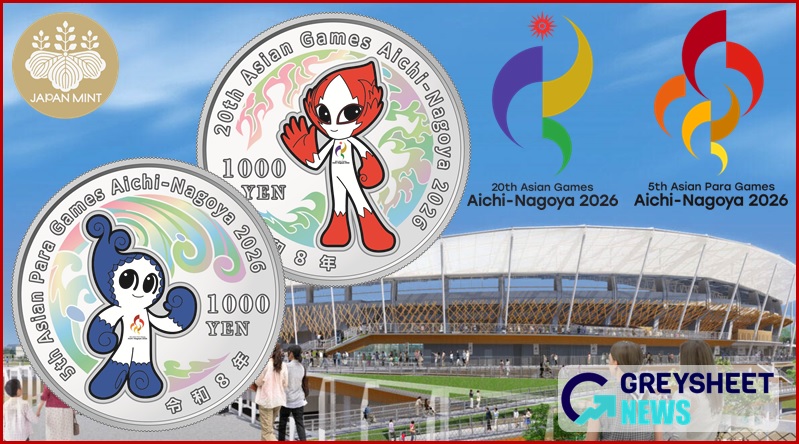
New Silver Proof and Colour Coins Mark Upcoming XXth Asian Games
From September 19 to October 4, the Japanese city of Nagoya will host the XXth Asian Games, in which a total of 15,000 athletes representing 45 countries will compete. A totsal of 55 venues will stage 41 sports.
The XXth Asian Games are represented by the mascot named Honohon and which is derived from the Japanese word honoho believed to be the origin of the word meaning flame. The design and meaning of the mascot honohon was inspired from the fiery passion that dwells in the hearts of athletes, becoming one with Shachihoko, the guardian deity of Aichi-Nagoya.
Following the Asian Games, Nagoya will also host the fifth Asian Para Games Aichi-Nagoya from October 18-24. This major multi-sport event will feature 4,000 athletes from 45 Asian nations competing across 18 sports, including wheelchair basketball, athletics, and swimming.
The Aichi-Nagoya 2026 Asian Para Games is represented by a mascot known as Uzumin, based on the Japanese words Uzu meaning whirlpool and Izumi, meaning aquatic spring.The town of Aichi in the prefecture of Nagoya is known for its tranquil waters and beautiful bays, as well as it is leadership in manufacturing industries.
The coins are produced by the Mint of Japan at their facilities in Osaka on behalf of the Ministry of Finance.
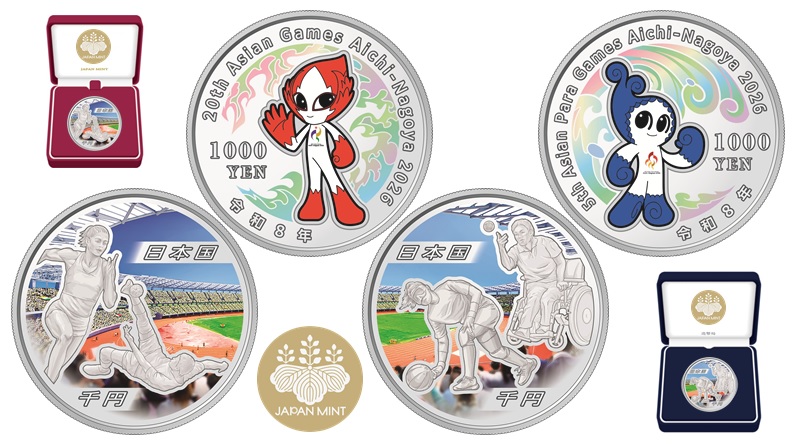
Coin 1 – Asian Games. The obverse features a colourful view of the Olympic stadium in the background. In the foreground, a female athlete running and a kick volleyball player. Kick volleyball is one the sports added to this year’s competition. To the right of the runner is the Japanese text 日本国 (Japan) and the denomination千円 (Thousand Yen) shown near the lower left. The reverse features a colour image of the mascot Honohon centred with a light colour background designed to symbolise fire. Surrounding the primary design along the rim is the commemorative text in English 20th Asian Games Aichi-Nagoya 2026. Along the lower left rim is the text 令 和 8 年 denoting the Imperial year 8 of the era of Reiwa – regnal name of HIM Emperor Naruhito. The denomination 1000 YEN is shown just to the left of Honohon.
Coin 2 – Asian Para-Games. The obverse features a full colour view of the interior of the Olympic stadium in the background. In the foreground is a goalball player shown to the left, a team game developed for blind and visually impaired. To the right is an image of a boccia player in a wheelchair, a Paralympic sport discipline derived from the Italian game of bocce. Above the goalball player is the Japanese text 日本国 (Japan) and the denomination千円 (Thousand Yen) shown near the lower right. The reverse features a colour image of the mascot Uzumin centred with a light colour background designed to symbolise water and waves. Surrounding the primary design along the rim is the commemorative text in English 5th Asian Para Games Aichi-Nagoya 2026. Along the lower right rim is the text 令 和 8 年 denoting the Imperial year 8 of the era of Reiwa – regnal name of HIM Emperor Naruhito. The denomination 1000 YEN is shown just to the right of Uzumin.
| Denomination | Metal | Weight | Diameter | Quality | Mintage Limit |
| 1000 Yen X 2 | .999 Silver | 31.1 g. | 40 mm. | Proof & Colour | 25,000 each |
Each silver Proof and colour coin is encapsulated and presented in a custom case accompanied with a certificate of authenticity in Japanese and English text. For additional information, please visit the Mint of Japan’s list of authorised international distributors.
Poland – Mint of Poland

New Cylindrical-Shaped Silver and Bullion Bar-Shaped Gold Coins Highlight Bank’s Reserves
The Narodowy Bank Polski offers silver and gold collector coins as part of the on-going series entitled Independent Central Bank, this year highlighting NBP’s Gold Reserves. Devoted to key aspects of the central bank’s operations, this particular series devotes focus to key aspects of the central bank’s operations and the mechanisms behind the stability of the Polish economy.
Gold has been considered an attractive and reliable store of value for centuries, due to its physicochemical properties such as ductility, malleability and corrosion resistance. These qualities make it a durable and virtually indestructible raw material. The value of gold priced as a commodity remains largely independent of economic conditions and turmoil over the long term.
Currently, Poland’s gold reserves amount to 580 tonnes, ranking Poland 12th among the world’s central banks. The gold is stored in the vaults of the Bank of England in London, the Federal Reserve System in New York and in a secure depository in the Narodowy Bank Polski. The aim of diversifying the locations where gold is stored is aimed to reduce geopolitical risk, which could result in the loss of gold reserves or restrictions on the ability to dispose of them freely.
The gold stored at Narodowy Bank Polski meets the requirements and requisites set by the London Good Delivery quality standard set by the London Bullion Market Association. This guarantees the bars belonging to NBP have the appropriate fineness, precise marking, and the correct dimensions and weight.
The national currency (złoty), gold reserves and an independent central bank together form one of the foundations of Poland’s free-market economy. This also allows the NBP to pursue a sovereign monetary policy aimed at maintaining macroeconomic stability.
The silver and gold Proof coins are produced by the Mint of Poland at their facilities in Warsaw on behalf of the National Bank.
100 Złotych – Silver. Designed by Ursula Walerzak, this cylindrical-shaped coin depicts detailed graphic elements of the NBP’s head office on Świętokrzyska Street, Warsaw which features the building, the vault and stacked gold bars, as well as an image of the entrance to the main banking hall of the former Bank Polski SA, located in Bielańska Street in Warsaw. Etched columns flank the images of the headquarters and entrance, and a decorative element is located between the columns. The top or obverse surface depicts an image of the crowned eagle established as the state emblem of the Republic of Poland, centred. Along the rim and surrounding the crest is the inscription RZECZPOSPOLITA POLSKA (Republic of Poland) and the year of issue, 2026. The reverse features the face value 100 ZŁOTYCH centred along with the inscription NIEZALEŻNY BANK CENTRALNY – RESERWY ZŁOTA (Independent Central Bank – Gold Reserves) placed around the denomination along the rim.
500 Złotych – Gold. Designed by Pawel Pietras, the obverse of this gold-bar shaped coin features the image of a stylised fragment of a vault door with its bolts shown around the circular interior. Centred on the inside of the vault door is an image of the crowned eagle, established as the state emblem of the Republic of Poland. Placed above the vault is the text RZECZPOSPOLITA POLSKA along with the year of issue, 2026. Below the primary design is the coin’s denomination 500 ZŁ. Viewed horizontally, the reverse features the insignia or logo of the Narodowy Banki Polski and focuses on the bank’s initials – NBP which is placed to the right side. To the left is the inscription NIEZALEŻNY BANK CENTRALNY – RESERWY ZŁOTA – NBP. Below this is the coin’s metallic symbol and fineness, Au999,9.
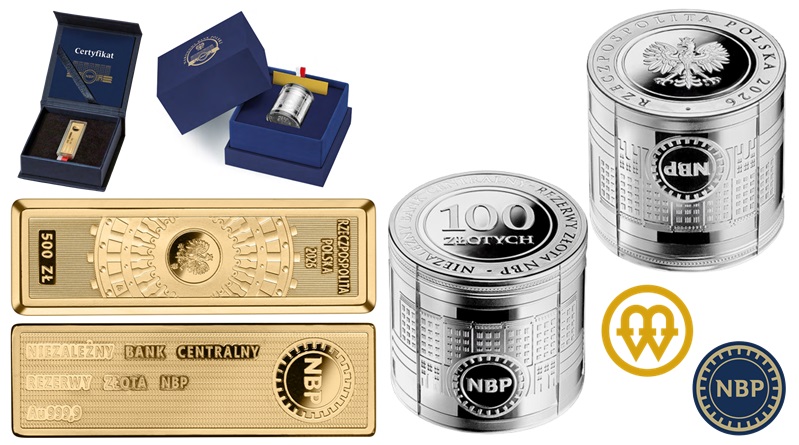
| Denomination | Metal | Weight | Dimensions | Quality | Mintage Limit |
| 100 Zlotych | .999 Silver | 311.0 g. | 34 / 32 mm. | Reverse Proof | 1000 |
| 500 Zlotych | 999.9 Gold | 31.1 g. | 35 / 10 / 4.8 mm | Proof | 1000 |
Each gold and silver coin is specially encapsulated to accommodate their particular shape and presented in a high-grade card case accompanied by a certificate of authenticity. The 100 złoty cylindrical shape silver coin will be sold exclusively at NBP regional branches and will not be available for sale in the online shop Kolekcjoner. The gold pieces can be purchased from the e-webshop of the National Bank of Poland.
United Kingdom - The Royal Mint
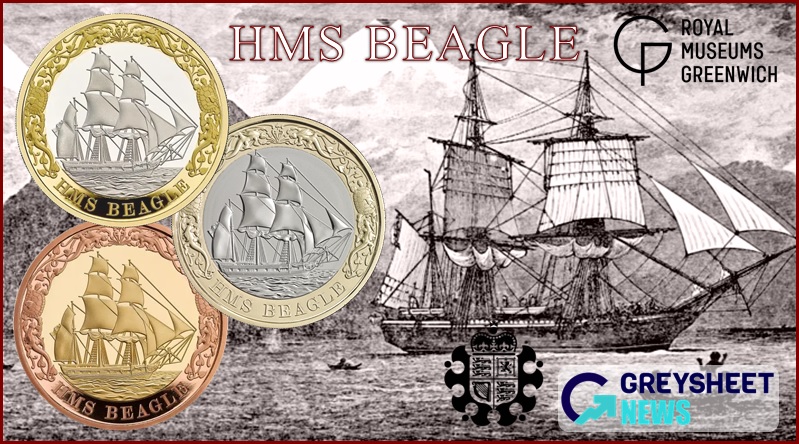
The Royal Mint Marks the Bicentenary of HMS Beagle's First Voyage.
One of Britain’s most iconic ships of exploration whose legacy would go on to transform our understanding of life on Earth is remembered in a collaborative effort with Royal Museums Greenwich. Although the HMS Beagle may not be a household name, her legacy is undeniable.
Originally launched in May 1820at Woolwich Dockyard on the River Thames, the 10-gun Cherokee class brig-sloop, measuring about 90 feet long was designed for coastal survey work. After the first voyage in 1826, the HMS Beagle’s second expedition established the ship as one of the most important and famous vessels in world history.
Setting sail in 1831, HMS Beagle charted a course along the coasts of South America before continuing to the Galápagos Islands and beyond. Along the way, Charles Darwin’s observations of unique wildlife to dramatic geological formations – would go on to shape his revolutionary theory of evolution by natural selection. The journey would last from December 1831 until October 1836 and during their travels, Darwin spent most of his time on land, with his discoveries and detailed observations eventually leading to the publication of his ground-breaking theory of natural selection.
In 1839, Darwin’s theory of natural selection consisted of the hypothesis that all species of life have evolved over time from common ancestors. Another naturalist and explorer, Alfred Russel Wallace, independently came up with the same concept and the two men’s ideas were released together in 1858 at which time Darwin published his ideas in full in On the Origin of Species the following year.
With its final years in the service of surveying, HMS Beagle was commissioned in 1845 to guard the Essex coast against smuggling. Sadly, the imposing ship was finally sold in 1863 and unceremoniously broken up for its timber.
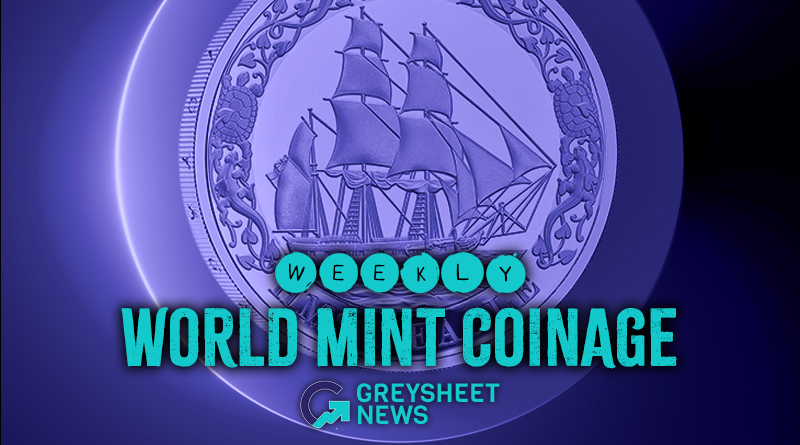
The reverse design, created by William Webb, depicts HMS Beagle centred sails furled, and surrounded by a decorative border of distinctive wildlife inspired by Darwin’s ground-breaking observations. Along the lower rim is the text HMS BEAGLE. The obverse includes the effigy of HM King Charles III created by engraver Martin Jennings. The denomination 2 POUNDS and the year of issue, 2026 is shown as part of the legend surrounding the King’s likeness. The incused edge lettering reads • THE VOYAGE OF THE BEAGLE.
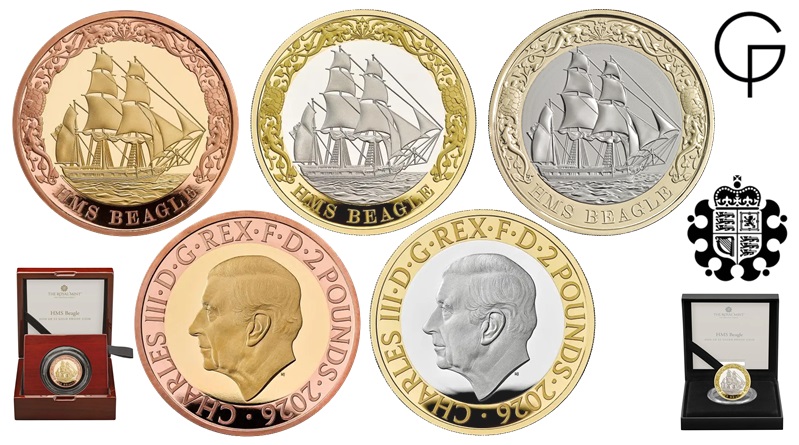
| Denomination | Metal | Weight | Diameter | Quality | Mintage limit |
| 2 Pounds | Bi-metallic | 12 g. | 28.4 mm. | BU | Unlimited |
| 2 Pounds | .925 Silver | 12 g. | 28.4 mm. | Proof | 2000 |
| 2 Pounds | .925 Silver | 24 g. | 28.4 mm. | Proof | 1000 |
| 2 Pounds | .9167 Gold | 15.98 g. | 28.4 mm. | Proof | 100 |
The BU bi-metallic base metal coins are housed in a blister-pak type folder with informative text and illustrations. The sterling silver Proof and silver piedfort coins are presented in a custom black vinyl-covered case and the gold Proof coins are presented in a polished hardwood case – all are accompanied with a numbered certificate of authenticity. For additional information, please visit the Royal Mint’s e-webshop.
Related Stories (powered by Greysheet News)
View all news

Please sign in or register to leave a comment.
Your identity will be restricted to first name/last initial, or a user ID you create.
Comment
Comments