

Bulgaria. First Euro Denominated Collector Coin Marks 125th Anniversary of Electric Trams
The Bulgarian National Bank release new silver proof coins highlighting an important transport milestone.
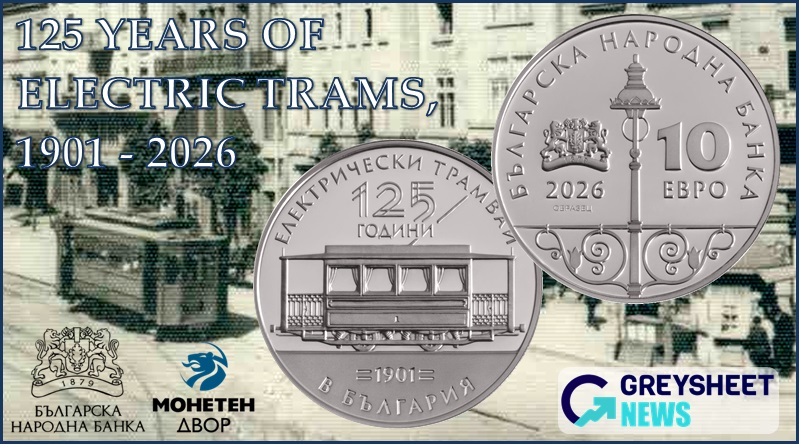
The first collector coins for 2026 are also the first to be denominated in Euro since the country’s transition from the Lev to the single currency on the 1st January of this year. It was on the 14th January 1901 that the country’s first electric tram ran in the capital of Sofia. During a launch ceremony in the presence of the city’s mayor the first Tram inaugurated its route from the central railway station through the Lions’ Bridge to the Slaveykov Square. The entire journey took an impressive forty minutes at that time and the emergence of electric trams on Sofia streets was associated with the economic development of the city.
The first trams were green in colour, comprising 24 railcars and trailers delivered from Belgium. They were small in size but with open platforms and decoratively fenced with metal grilles for safety. The cabins were divided into first class with velvet seats and second class with wooden benches. Initially, the service ran on six routes on a single rail track, with a total length of 23 kilometres or, 14 miles and passing loops at key points. As the system was an entirely new transport concept, there were no designated stops, the tram would stop at passengers’ signal and the conductor would walk along a special outer ledge on the tram car. The ticket price was based upon distance and travel time, passengers would pay about 15 stotinki for a first class seat or 10 stotinki for second class.
That year, Sofia became one of the first ten European capitals with an electrified public transport system. The electric tram itself became a symbol of national pride, modernisation and progress in a newly independent Bulgaria, sparking interest and curiosity among city’s residents and visitors. As the new electric vehicles replaced horse-drawn omnibuses, it was now possible to travel to some outlying villages which were not yet districts of Sofia. An important location for the new city railway network was the City Garden, surrounded on all sides by tram lines. In 1900, a trams depot was first built and which operated until 1928, serving not only as a vehicle shed but also as a service and repair station.
Today, Sofia's tram service remains a key public transport network featuring 17 lines covering 154 kilometres or 95 miles, making it the largest system in the Balkans. The service offers extensive coverage of the city centre and major neighbourhoods with modern, air-conditioned trams alongside vintage cars, using dedicated tracks that contribute to less traffic on the city’s streets.
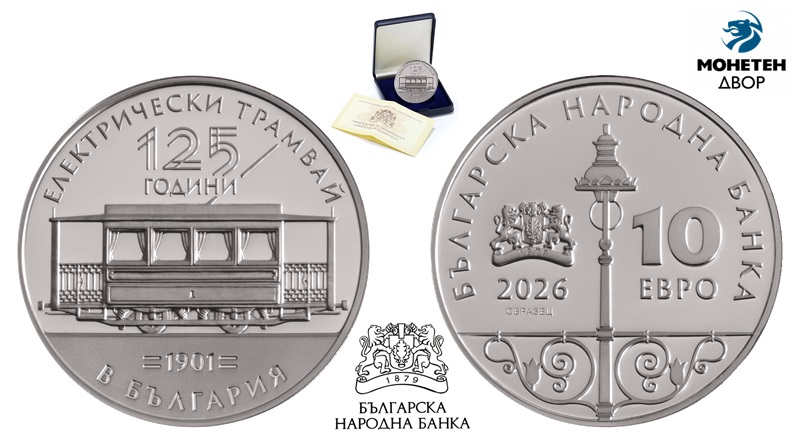
The silver proof coins produced by the Mint of Bulgaria at their facilities in Sofia and on behalf of the National Bank. Designed by Svetlin Balezdrov, the obverse side features a detailed image of the first tram cars, highlighting the platforms on the front and rear with curtains decorating the windows. Above the design and along the upper rim is the inscription ЕЛЕКТРИЧЕСКИ ТРАМВАЙ (Electric Trams) along with the stylised numeral 125 and text ГОДИНИ (years). Below the tram car is the commemorative year 1901 and along the lower rim is a continuation of the commemorative text В БЪЛГАРИЯ (in Bulgaria). The reverse side includes the image of a vintage city street lamp with its decorative ironwork centred. To the left is the emblem of the Bulgarian national Bank and to the right, the new denomination 10 ЕВРО (euro). The text БЪЛГАРСКА НАРОДНА БАНКА (Bulgarian National Bank) is placed along the upper rim above the primary design.
| Denomination | Metal | Weight | Diameter | Quality | Mintage Limit |
| 10 Euro | .999 Silver | 23.3 g. | 38.6 mm. | Proof | 5000 |
Available from the 26th January, each coin is encapsulated and presented in a case accompanied with a certificate of authenticity. Collectors in Bulgaria can obtain the coin in person at the BNB Cash Centre, 10, Mihail Tenev Street and in offices and branches of commercial banks. The coin will be available from the e-webshop of the Bulgarian Mint from the 9th February. For additional information, please visit their retail website.

Download the Greysheet app for access to pricing, news, events and your subscriptions.
Subscribe Now.

Subscribe to RQ Red Book Quarterly for the industry's most respected pricing and to read more articles just like this.
Visit these great CDN Sponsors
CDN Sponsors






Author: Michael Alexander
 Michael’s background in both numismatics and banknotes spans more than three decades and whose activities have varied from being a dedicated world coin collector to coin & medal design, marketing, theme concept and production. His additional interests include banknote research and in 1997, he founded the London Banknote and Monetary Research Centre to further these interests and activities. The company continues to offer monthly currency bulletins to both online and printed publications which includes information about the latest banknote news and releases from Central Banks and Monetary Authorities around the world. Michael has been a contributor to COIN NEWS magazine based in the UK since 1998 where many of his in-depth interviews, articles and bulletins have been published.
Please sign in or register to leave a comment.
Your identity will be restricted to first name/last initial, or a user ID you create.
Comment
Comments