




 Whitman Expo
Aruba. New Proof and Colour Silver Coins Released to Mark 40 Years of Autonomy
The Central Bank of Aruba Release new festive silver coins marking a special national anniversary.
by Michael Alexander |
Published on March 27, 2026

Download the Greysheet app for access to pricing, news, events and your subscriptions.
Subscribe to RQ Red Book Quarterly for the industry's most respected pricing and to read more articles just like this.
Advertisement
This year, the Caribbean island of Aruba celebrates two special national milestones beginning with the 40th anniversary of autonomy and 50 years since the adoption of the Flag and National Anthem. On the 1st January 1986, Aruba became an autonomous country within the Kingdom of the Netherlands. This change of status was a significant moment for the country and now, four decades later Aruba has further strengthened its identity.
Today, Aruba, along with Curaçao, and Sint Maarten are constituent countries within the Kingdom of the Netherlands, with Aruba’s internal autonomy known as Status-Aparte, a Latin term meaning separate state. Matters such as foreign affairs and defence are still handled by the Netherlands. Prior to the granting of this autonomy, Aruba was part of the Netherlands Antilles, a self-governing entity comprising all Dutch Caribbean possessions with the Dutch monarch as Head of State. The framework for self-government was first discussed in August 1947, when Aruba formulated its first staatsreglement or, constitution for the granting of status-aparte as an autonomous state within the Kingdom of the Netherlands. The change of status was initially prompted by the efforts of Henny Eman (1887 – 1957) a noted Aruban politician and by 1954, the Charter of the Kingdom of the Netherlands was established, providing a framework for relations between Aruba and the rest of the kingdom.
That particular framework also created the Netherlands Antilles, uniting all of the Dutch colonies, including Aruba into one administrative structure. Though many Arubans were unhappy with the arrangement, another eighteen years would pass before another proposal was put forth for a change in Aruba’s status.
In 1972, Aruban politician Betico Croes proposed the creation of a Dutch Commonwealth of four states to include the Netherlands, a separate Aruba, the Netherlands Antilles and Suriname in South America with each country to be equal and independent. In preparation of eventual independence, Aruba adopted both a new flag and a national anthem in 1976. Further, in March 1977, a referendum was held on the island of Aruba with the support of the United Nations in which 95% of the participants voted for complete independence from the Netherlands and 5% to remain within the Netherlands Antilles.
Agreements were reached in March 1983 in which Aruba obtained an official agreement within the kingdom for its full independence, to be developed in a series of steps as the Crown would grant increasing autonomy. As art of this agreement, Aruba drafted a constitution that was unanimously approved in August 1985 and on the 1st January 1986, Aruba seceded from the Netherlands Antilles, officially becoming a separate country within the Kingdom of the Netherlands. Although full independence was planned for 1996 as part of the 1983 agreements, the governments of Aruba, the Netherlands, and the Netherlands Antilles indefinitely postponed Aruba's transition to full independence in 1990. The article scheduling this final status was rescinded in 1995, although it was decided that the process could be revived after another referendum at the choosing of the Aruban government.
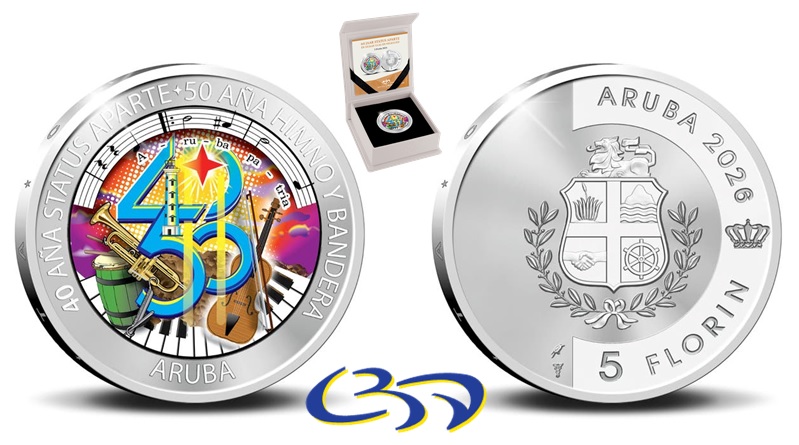
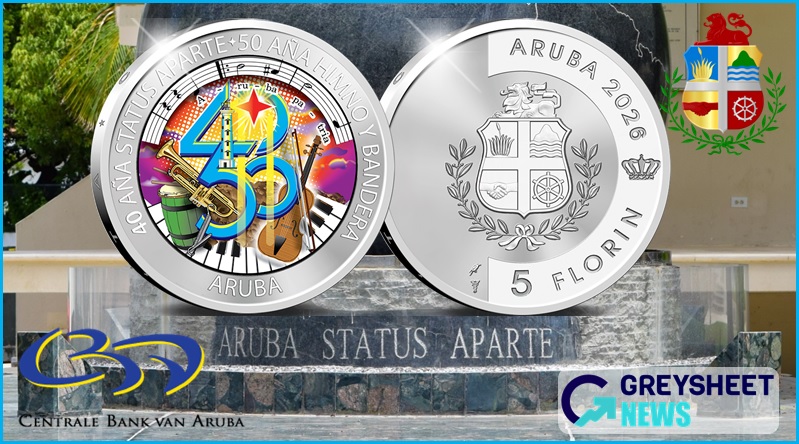
The silver prooflike and colour coins are produced by the Royal Dutch Mint at their facilities in Houten, Netherlands and on behalf of the Central Bank of Aruba. The island’s two national anniversaries are both featured on the obverse. The numbers 40 and 50 are shown in blue lettering, referring to the granting of Status-Aparte and the adoption of the national flag and anthem. A red, four-pointed star that is part of the Aruban flag is placed just over the numeral 40. The festive inclusion of colour images of a keyboard, musical scores, drums, violins and trumpets refer to Aruba’s lucrative tourist industry and the national anthem. The text A –ru –ba pa –tria is found just along the musical score. The primary design is surrounded with commemorative text along the rim that reads 40 ANA STATUS APARTE – 50 ANA HIMNO Y BANDERA. The reverse side features the official Aruban crest centred along with miniature national flag depicted in full colour shown to the left of the crest and the representation of the Dutch crown placed to the right. The text ARUBA 2026 and 5 FLORIN is placed along the right rim. The edge of the coin includes incused lettering which reads DIOS * TA *CU * NOS*
| Denomination | Metal | Weight | Diameter | Quality | Maximum Mintage |
| 5 Florin | .925 Silver | 25 g. | 38 mm. | Prooflike & Colour | 700 Pieces |
Available from the 19th March, each coin is encapsulated and presented in a matte white heavy-gauge card custom case accompanied with a certificate of authenticity. For additional information, please visit the e-webshop of the Royal Dutch Mint.
Related Stories (powered by Greysheet News)
View all news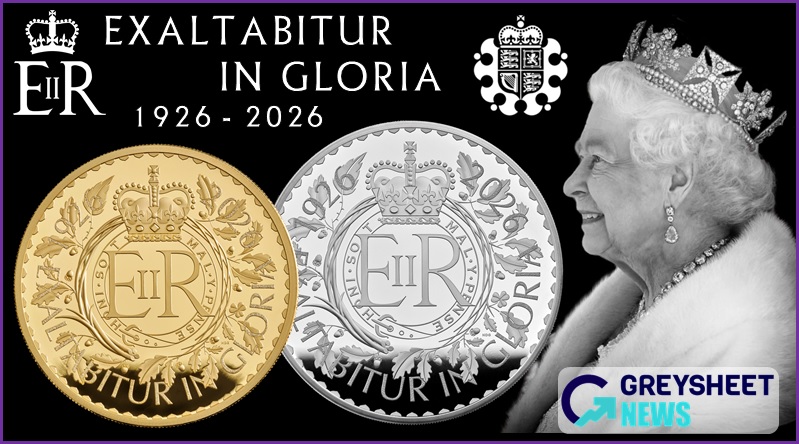
The Royal Mint release new collector coins marking the Late Queen's 100th anniversary of birth.

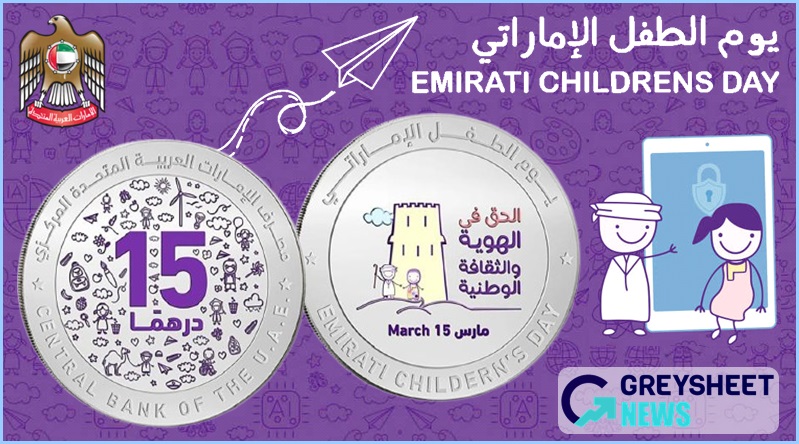
The Central Bank of the United Arab Emirates release silver collector coins highlighting Children's Day.
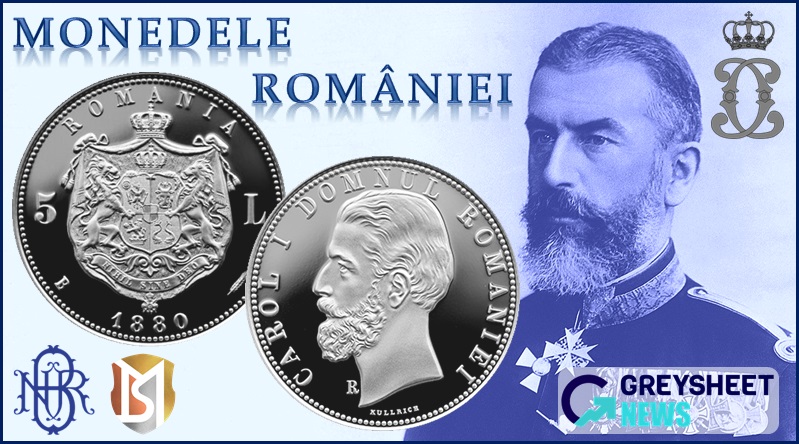
The National Bank of Romania launch The Coins of Romania series focusing on historic numismatic classics.
Please sign in or register to leave a comment.
Your identity will be restricted to first name/last initial, or a user ID you create.
Comment
Comments